

Site Search
Contact Us
Speak to a licensed and experienced insurance agent in the United States.
- Office Hours:US Central Time
- {{allSevenDays}}
- Mon-Fri
- Current Time:
- Call Us:
- Toll-Free: +1 (866) INSUBUY
- Local: +1 (972) 985-4400
- WhatsApp: +1 (972) 795-3223
- Chat With Us:
Manage your coverage faster—extend, cancel, or correct your policy through MyAccount.


Stevens Institute Of Technology
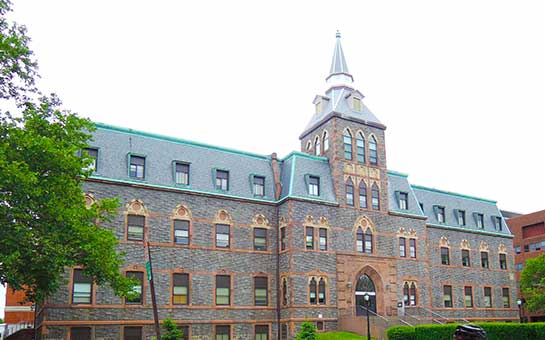
Stevens Institute Of Technology International Student Insurance
Stevens Institute of Technology, located in Hoboken, New Jersey, was established in 1870. It was named for and founded by the Stevens family, “America’s First Family of Inventors,” whose various members were crucial in the development of everything from steam ferries to commuter trains to cowcatchers to railroad tracks. When Edwin A. Stevens died in 1868, his will dictated the establishment of a university. The school opened two years later and originally offered a single degree in mechanical engineering. Since then, Stevens has expanded into a global technical institution with strengths in fields like defense, maritime engineering, management, and finance. The first women were admitted in 1971.
Today, Stevens enrolls about 7,000 students and counting each year. The school’s colors are Stevens Red and gray, and its athletic nickname is the ducks.
Research Achievements and Opportunities
In 1982, Stevens became the first U.S. university requiring students to purchase and use personal computers. Simultaneously, it also developed one of the country’s first intranet systems. Stevens alumni are responsible for developments like IMAP (the modern form of email); bubble wrap; and the Gantt chart, a type of bar chart illustrating project schedules. Stevens alumnus Frederick Reines won a Nobel prize for his discovery of the neutrino, which validated the “Big Bang” theory of creation. Another alumnus is artist Alexander Calder, who invented the art form of hanging mobiles.
Stevens houses three research initiatives designated as Centers of Excellence by the U.S. government. They are the National Center for Secure and Resilient Maritime Commerce, the National Systems Engineering Research Center, and the Atlantic Center for the Innovative Design and Control of Small Ships. Other research institutes include the Center for the Advancement of Secure Systems and Information Assurance, the Center for Maritime Systems, and the Center for Innovation in Engineering and Science Education.
Campus Traditions
One notable tradition at Stevens is the Stevens’ Innovation Expo (also known as “Senior Design Day” or “D-Day”). The event showcases capstone projects from undergraduate seniors and includes a Project Plan Pitch and an Elevator Pitch Competition, which helps students hone the feasibility and marketability of their projects. Many students use their projects as a foundation to form companies or business ventures after graduation.
J Visa Insurance Plans
Patriot Exchange Program℠
ExchangeGuard® Choice
ExchangeGuard® Essential
Student Health Advantage℠ Standard
Student Health Advantage℠ Platinum
StudentSecure® Smart
StudentSecure® Budget
StudentSecure® Select
StudentSecure® Elite
Atlas America®
Atlas Essential America
F Visa Insurance Plans
This school does not allow to purchase outside insurance or no insurance plans available that meet the school requirements.