

Site Search
Contact Us
Speak to a licensed and experienced insurance agent in the United States.
- Office Hours:US Central Time
- {{allSevenDays}}
- Mon-Fri
- Current Time:
- Call Us:
- Toll-Free: +1 (866) INSUBUY
- Local: +1 (972) 985-4400
- WhatsApp: +1 (972) 795-3223
- Chat With Us:
Manage your coverage faster—extend, cancel, or correct your policy through MyAccount.


California Institute of Technology
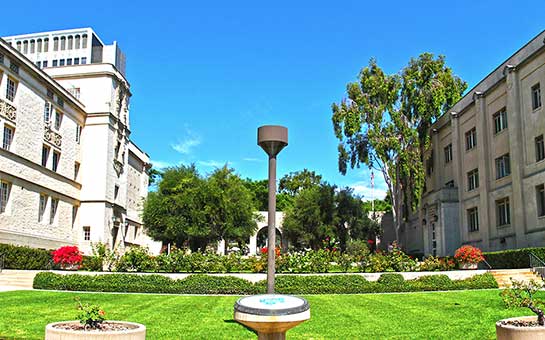
California Institute of Technology International Student Insurance
The California Institute of Technology (Caltech), located in Pasadena, California, was established in 1891. It’s a private university and research institute dedicated to instruction and research in the fields of science and engineering. Its six academic divisions consist of biology; chemistry and chemical engineering; engineering and applied science; geologic and planetary sciences; humanities and social sciences; and physics, mathematics, and astronomy. Caltech enjoys a reputation as one of the top universities in the world; it counts among its faculty and alumni Nobel Laureates, Fields Medalists, Turing Award winners, and National Medal of Science and National Medal of Technology winners.
Today, it enrolls about 2,200 students and counting, more than half of whom are graduate students. The school’s colors are orange and white, and its athletic nickname is the beaver.
On Campus
Caltech has been involved with numerous scientific and technological achievements since the second half of the 20th century in particular. In 1958, the school’s Jet Propulsion Laboratory worked with NASA to launch Explorer I, the first United States satellite. It also runs astronomical observatories at Owens Valley, Mount Palomar, and Big Bear Lake (all in California) and Mauna Kea (in Hawaii).
Other Caltech research institutes and collections include the Infrared Processing and Analysis Center, which provides science operations and data management for astronomy and planetary science missions; the Seismological Laboratory, which serves as a national and worldwide focal point for earthquake research; and the Kerckhoff Marine Laboratory, a marine biology lab established in 1928.
Notable Faculty and Alumni
Notable faculty from Caltech include Nobel Prize-winner Andrews Millikan (of the famous oil-drop experiment), who served as the school’s Chairman of the Executive Council from 1921–1945; physicists Richard Feynman and Murray Gell-Mann; astronomer George Ellery Hale; and chemist Linus Pauling. Notable alumni include Nobel laureate Carl David Anderson, discoverer of the positron; Benoit Mandelbrot, father of fractal geometry; Academy Award-winning director Frank Capra; mathematician Stephen Wolfram; and NASA astronaut and U.S. Senator Harrison Schmitt, the only geologist to have walked on the moon.
J Visa Insurance Plans
This school does not allow to purchase outside insurance or no insurance plans available that meet the school requirements.
F Visa Insurance Plans
This school does not allow to purchase outside insurance or no insurance plans available that meet the school requirements.